Monday, 20 December 2021

An all round sad state of affairs.

Posted by Tony Hutton


I have so far tried to stay at arms length from the ongoing controversy surrounding Yorkshire county cricket club, which together with England's somewhat abject performances in Australia have brought about a rather gloomy outlook on the game as we enter the final weeks of what has been a trying year all round.

However recent attitudes from some quarters of the cricketing press do rather call for comment. I this week had a letter on the Yorkshire situation published in the Cricketer Magazine, who chose to edit it so much that the original message was lost. The theme of my letter was that if their 'investigative journalist' had dug a little deeper into Azeem Rafiq's past behaviour he might have realised that there could be an element of exaggeration in his allegations or even some reasons behind his alleged abuse. However these comments were not considered suitable for publication.

To emphasise the magazine's rather one sided view, their senior correspondent has apparently advocated lifetime bans on a long list of players mentioned in Mr Rafiq's 'evidence' as well as a suspension of Barnsley cricket club. Not much sign here of inclusivity or reconciliation which appeared in Lord Patel's initial statement following his appointment as Chairman.

A further mystery has been the Yorkshire Post newspaper's coverage of events. One would have thought that such a local issue would have brought extensive coverage and a flood of readers' letters. Let us not forget a leading article in the early stages which first suggested Yorkshire should lose the Test Match, which was as much a knee-jerk action as those from the incompetent ECB and the rather prejudiced MPs committee. Then the mysterious business of the paper's cricket correspondent's absence from the scene for the last few weeks and the only further comment being another leading article lauding the impending return of Darren Gough as some sort of messiah. All very strange.

At long last a letter from long-standing member David Tunbridge of Sheffield did appear in Sports Monday a week ago, which certainly echoed my thoughts on the matter, including reference to the sacking of sixteen good people without any opportunity of defending themselves. So although Lord Patel quickly settled with Azeem Rafiq, his next move is certainly open to question and has caused even more divisions which yesterday resulted in all the first team squad requesting permission to approach other counties.

So a sad state of affairs to which it is difficult to see an end. The long suffering members will at last be given a chance to air their opinions at a members' forum to be held at Headingley at 10 a.m. on Saturday 22nd January.

Saturday, 11 December 2021

Memories of Bellerive Oval, Hobart

Posted by Tony Hutton

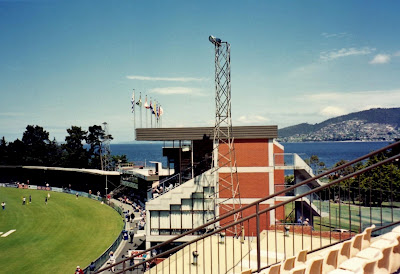
Yesterday's announcement that the fifth match of the current Ashes series in Australia will now be played at the Bellerive Oval, Hobart, Tasmania brought back memories of my visit there on a previous England tour in 1994/95. The move from Perth has been brought about by the strict covid rules applied by the Western Australian government. Test matches have previously been played in Hobart but never before by England. This has been a controversial decision to select the small ground, which only has a  20,000 capacity, over the much bigger stadiums of Melbourne and Sydney, but has been welcomed by the television companies as the game will be a day/night affair, which helps get a bigger audience in the UK and elsewhere.

Bellerive Oval, Hobart 1994

The game I saw back in November 1994 was a warm up game between an Australian XI and an England XI, immediately before the first test in Brisbane. As now England were underdogs with a few controversial selections in the touring party. The pace bowling looked rather thin with the inexperienced Darren Gough, Martin McCague, an Irishman brought up in Australia, and Joey Benjamin of Surrey playing in this game. The spinner was Phil Tufnell and wicket keeper Steven Rhodes of Worcestershire.

River estuary view at Bellerive Oval.

The strength of the England side was in the batting line up of Atherton the captain, Stewart, Thorpe, Gooch, Crawley and all rounder Craig White. The Australian XI also has a strong batting side with Hayden, Blewett, Langer, Damien Martyn the captain, Ricky Ponting a local boy, then only 19 years old, and Stuart Law. Two other local Tasmanians in the side were wicket keeper Atkinson and spinner Robertson, together with the pace bowlers Merv Hughes, Paul Reiffel and Jo Angel.

Think the grassy bank may have now disappeared.

The attractive setting of the ground, overlooking the Derwent River estuary was matched by the hospitality provided to the handful of England followers who were welcomed into the members' enclosure. Fortunately some time before the Barmy Army took centre stage. Australia made a poor start losing Hayden and Langer early on and then Blewett with the total on 99-3. However Martyn and the young local boy Ponting came together to put on a partnership of 133. Ponting had already impressed with 82 in the first game of the tour at Lilac Hill.

Play in progress in 1994.

Martyn, who later had a brief but memorable time at Yorkshire, went on to a century, ably supported by Ponting with 71, Law with 68 and Atkinson with 51 not out, before the home side declared after an hour of day two with an impressive total of 386-7. The England bowling figures did not look good with the first test rapidly approaching. Gough had 1-101, McCague 3-115 and Tufnell 1-62. The batting was not much better only Gooch and Rhodes with fifties impressing as the three Australian pacemen shared the wickets.

Another view from 1994.

England all out for 209 were invited to follow on after day three was almost completely lost to rain. They did manage a much better performance in the second innings and were able to bat out for a comfortable draw. Alec Stewart made an impressive century and Atherton (49) and Thorpe (48 not out) also looked in good form as the game finished with a score of 207-1.

This game and all the other warm up games in Perth, Adelaide, Canberra and Newcastle did not seem to prepare England very well for the upcoming first test in Brisbane, with yet another predictable home victory. Michael Slater set the tone for the series with a four off the first ball from De Freitas and went on to score 176. Together with a century from Mark Waugh this enabled Australia to total 426. In a game very similar to the one that finished today McDermott bowled England out cheaply in the first innings and Shane Warne's bowling destroyed them in the second with 8-71.


Thursday, 9 December 2021

Two seasons without Cumberland cricket.

Posted by Tony Hutton

Thinking back the other day I realised that two cricket seasons have passed me by without seeing Cumberland county cricket club in action. Of course this is largely due to the covid epidemic, but also in part to the recent reorganisation of what was Minor Counties cricket, so treasured by many of us from the older generation. The new National Counties set up in it's place, which has been prodded and poked by the already dysfunctional English Cricket Board, has reduced the number of three day games by such an extent that you can hardly find any to watch anyway. In addition last season the name of the club was changed to Cumbria county cricket club, the administrative county which took in Westmorland and parts of Lancashire and the West Riding of Yorkshire many years ago.

I go back a long way with Cumberland, having seen their very first Minor Counties game, as a teenage spectator, against Yorkshire seconds at Edenside, Carlisle, way back in 1955. After that, exile in the Midlands for twenty years and work commitments meant that I did not see them again, apart from one game against Warwickshire seconds at Edgbaston, until about forty years later. Then one of the benefits of enforced early retirement made it possible to join the club as a member, which I have remained ever since. 

Edenside, Carlisle.

Probably the most memorable game here was the 2015 championship decider against Oxfordshire. Cumberland won in quick time on day two of a scheduled four day game by bowling the visitors out for 85 and 89 and then requiring only five to win, doing so by ten wickets. Toby Bulcock, the left arm spinner now with Staffordshire, was one of the top performers along with paceman Richard Gleeson, who soon afterwards joined Northamptonshire.


The proud picture banner of our blog site at Sedbergh School is of course one of the Cumberland grounds, now sadly taken over by Lancashire county cricket and 'discovered' by the cricketing media, which means bigger crowds and a lack of the peaceful atmosphere to which I have been accustomed for so many years. Here is one of the alternative views of the ground of which I have many.

Sedbergh School cricket ground.

The last time I saw Cumberland play was in July 2019 at the Netherfield cricket ground in Kendal, when rain on the last day robbed the home side of victory over Cambridgeshire. I have seen many games on this attractive ground over the years and believe it was 1999 when Cumberland beat Dorset to win the league title in a thrilling encounter. Steve O'Shaughnessy, once of Lancashire and now a first class umpire, scored a century in the first innings and in a run chase on day three Ashley Metcalfe, formerly with Yorkshire, won the match with another century.

However the top scorer in this high scoring game was a young twenty year old, Andrew Sexton of Dorset, who made 196 in Dorset's second innings. He made only a handful of appearances for Hampshire, but sadly then disappeared from the first class game. He did not play for Dorset again and seemed content to play league cricket for the rest of his career.

Cricket at Netherfield, Kendal.

Some of my earliest memories of Cumberland cricket were at the wonderful Keswick cricket club. However the problem there always seemed to be the weather with rain, and lots of it, a regular feature. There certainly were some fine days and some good cricket. I remember well a visit from Durham county cricket, I think for a benefit match when the unknown opening bat for the county, who made quite a few runs, turned out to be the club physio. David Boon and a young Paul Collingwood also played.


Fitz Park, Keswick.

Over the years I have managed to celebrate some of my notable birthdays by watching Cumberland cricket. The first attempt for my 65th ended in failure as the scheduled 38 county knock out game with the Yorkshire Cricket Board at Millom was called off after overnight night, despite a fine day. So a picnic lunch on the beach at nearby Silecroft was the order of the day.

Millom cricket club on an earlier occasion, when play actually took place.


Five years later I was at Workington for another one day trophy game between Cumberland and Herefordshire when my son and grandson flew in unannounced from Dubai. I have been a member of both counties for many years and they gave me a game to remember when Cumberland chasing 207 to win put on 39 for the last wicket only to lose by one run. At dinner that night my three year old grandson announced to all and sundry 'my grandad is seventy years old today'.

The Ernest Valentine ground, Workington.


Ten years later I was back at Netherfield for another one day game between Cumberland and Norfolk to celebrate my 80th birthday. This time a high scoring affair with Norfolk making over 300 and Cumberland out for 263 with just one ball of their innings remaining. All happy days indeed.

I also have happy memories of Cumberland games at the two Barrow grounds, Furness cricket club and Barrow cricket club. Again early days' memories at Barrow, sitting with the late Keith Hornby on the grass bank alongside the pavilion, while the conversation flowed all day. This a regular feature of all Cumberland games, home and away, when the former secretary Gilbert Johnstone and long serving treasurer Eric Carter were always full of stories from the past and providing detailed information of the players now appearing.

Barrow-in-Furness cricket club, with the hospital buildings behind, 2005.

Gilbert Johnstone, in the green cap, looks to be on the receiving end at Furness C.C.


Hopefully old memories can be revived during the 2022 season, old haunts to be re-visited and old friendships renewed.

Saturday, 4 December 2021

More Warwickshire memories

 Posted by Tony Hutton

Thanks to John Winn for his last two posts which perhaps take our minds off the unfortunate events concerning Yorkshire County Cricket club. Much more on that in due course no doubt when the dust settles on the current hiatus, if it ever does.

John's story on Jack Parsons certainly rekindled memories for me as, believe it or not, I actually saw him play. I think I have written before about a match I saw at Edgbaston way back in April 1951 between Warwickshire and an Old England XI. However I have so far been unable to find it on our archive. Anyway the Rev. Canon J.H. Parsons appeared in this game at the ripe old age of 60. He was often talked about in those days as a famous pre-war big hitter whose speciality was hoisting the ball over the old pavilion across the road into the region of Cannon Hill Park.

On this occasion he did not repeat the feat, but scored 15 before being bowled by a young whipper snapper called Jack Bannister, who of course much later wrote the history of Warwickshire which John referred to in his blog. Other former Warwickshire players in the Old England XI were R.E.S. (Bob) Wyatt still playing for Worcestershire at the time a few days before his 50th birthday and even older E.J. (Tiger) Smith the wicket keeper who became county coach, who was already 65.


Here is the team picture which John mentioned from 1914 which includes not only Parsons and Smith but one of the umpires from the 1951 game, the famous Warwickshire batsman W.G. Quaife, then aged 79. Sadly he died a few months after the game in 1951. Quaife had a remarkable career with Warwickshire making a century on debut in 1894 and another in his last game at the age of 56 in 1928. This final innings was by the oldest cricketer ever to score a championship century. During that time he accumulated over 36,000 runs and played seven times for England. A famous man indeed.

Some other notables in this well remembered game from seventy years ago include the other umpire Alex Skelding, opening bowlers Fred Root and Alf Gover, Errol Holmes of Surrey who captained the side, together with two Surrey team mates Laurie Fishlock and Donald Knight. The last named player will mean very little to most cricket followers of today, but not only did he score a century in the game in 1951 at the age of 57, but had played twice for England way back in 1921 some thirty years earlier.

For the record the game was played on a time basis, well before limited overs games came into fashion. Warwickshire made 214-6 declared in 60 overs, with a century from Jimmy Ord a batsman from Northumberland. In reply Old England made a valiant attempt at victory but finished just eight runs short with 8 wickets down in 55 overs. Another young pace bowler Ray Carter took two wickets in the first over of the innings and young Bannister did even better with 5-43. Knight's wonderful 112 came in 115 minutes with eighteen fours.


Warwickshire 1951 champions.

The practice match must have given Warwickshire some sort of impetus as they went on to win the County Championship that year for the first time in forty years.


Monday, 29 November 2021

WG comes to Halifax

 posted by John Winn

A recent visitor noticing my collection of Wisden's asked if I had read them all. My answer was that the best I could say was that I had not read any of them in their entirety but that I had read at least part of each copy of the almanac. One of the main pleasures that the collection gives is to take a copy from the shelves, open it at random and see what turns up. Rarely does this random approach fail to arouse my interest and today's blog stems from such an event.

Over the weekend I looked at the oldest almanac in the collection, that from 1889 which in the main covers the cricket in 1888, a season which saw an Australian tour, the sixth such tour of this country and to which 60 pages were devoted. The tour involved cricket almost every day from May 7th to September 22nd, Yorkshire played them three times. Inter county matches are not classified as 'county championship' but a table is printed which shows Surrey top with Kent and Yorkshire tied for second place. Two pages are given over to a match played at Hanson Lane, Halifax,'the first important match ever played on the new ground of Halifax Cricket and Football Club. The ground which was only laid out in 1887, is a spacious one, having a capital pavilion, facing one side for cricket and athletics and the other for football.'

Yorkshire's opponents for this significant game were Gloucestershire, skippered by Mr WG Grace, who having won the toss opened with his brother Mr EM. The West Country men did not fare well being bowled out for just 80, Peel 7 for 39, to which Yorkshire replied with 122, Peel top scoring with 25. Gloucestershire's second innings was only a little better than their first, 102 all out setting Yorkshire 70 to win which they achieved for the loss of seven wickets with Ulyett top scoring with 23. Man of the match was undoubtedly Peel for in addition to his first innings runs he took 13 wickets. 

Peel's record over the season qualified him for a feature in the almanack  'Six Great Bowlers of The Year' and  his statistics show he bowled 1768.1 overs, 886 of which were maidens and took 181 wickets at a cost of under 13. The portraits of the six were from 'fresh negatives taken by the well known Brighton firm of E Hawkins and co.' Alas time has not treated the photos kindly and they are very faded. 

The return match between Yorkshire and Gloucestershire was played at Clifton College in Bristol in August and this time it was the batters who were on top. WG for the third time in his career made centuries in both innings but Yorkshire showed great depth in batting and led by 213 on first innings. Grace's outstanding second innings effort when he batted over three hours saved the day for Glos and although Yorkshire batted a second time they were unable to hit off the 104 needed for victory in the time available

To close I must mention a curiosity of Yorkshire's season, namely a match they played at Sheffield in May against 23 (sic) colts. Despite having more than twice the customary number of players the youngsters were bowled out for 114 and 96 and lost by an innings and four, Peel taking 15 wickets in the match.

Saturday, 13 November 2021

A parson named Parsons

 posted by John Winn

Whilst researching my last posting, the subject of which was the Warwickshire cricketer Percy Jeeves, I came across a photograph of a Warwickshire XI taken in 1914 which included the aforesaid Percy. Accompanying the list of players is the note that only five of them played for Warwickshire immediately after the war. Of those who did not appear as soon as cricket resumed it is perhaps surprising that only one, Jeeves, was a casualty of the war whereas Frank Foster was forced to retire following a motor cycle accident, Septimus Kinneir retired, Syd Santall became coach which leaves only the subject of this posting, Jack Parsons or to give him his full title Reverend Canon John Henry Parsons MC, born 1890, died 1981. *

Jack Parsons was a sufficiently distinguished cricketer to merit a short biography 'Cricketer Militant' by Gerald Howat published shortly before the subject's death and a half page obituary in the 1982 Wisden. Like so many others Jack answered the call in 1914 joining the Warwickshire Yeomanry but his war service took him not, like Jeeves, to France but to Gallipoli which unlike thousands of British, Australian and New Zealand troops, he survived. In July 1916 he was commissioned as Second Lt in the Worcestershire Yeomanry with whom he stayed until transferring to the Indian Army. In March 1919 he returned to England arriving in time to see his mother shortly before her death on May 26th. A week later he was approached by Warwickshire and having accepted their terms he turned out in their first home championship match since 1914 against Derbyshire on June 9th and 10th, a match they lost and in which our hero scored 5 and 0. Parsons soon discovered his old form however and in twelve innings hit over 500 runs at an average of just under 50. His last appearance of the summer was against  an Australian Services XI for in August army duties took him back to India where he played some cricket and got married. 

In June 1922 he was again offered terms by Warwickshire which he refused, but in 1923 he returned to England and picked up where he had left off four years earlier with a century in his second match v Northants at Edgbaston and once again he finished the season top of the averages. Parsons returned to regular cricket in 1924 and continued until 1934 when he was in his 44th year and twenty years after he had played for the Players at the Oval. His final appearance could not have been better for playing against Yorkshire at Scarborough, Warwickshire were bowled out for 45 but when set 216 to win JHP hit 94 including three sixes and twelve fours and only 12 were needed when he was out and the winning runs were hit by JH 'Danny' Mayer, a great Warwickshire servant whose obituary appears two pages before that of Parsons in Wisden.

Having been ordained in 1929 and from 1934 to 1940 Parsons enjoyed life as a country rector in Shropshire and later Cornwall with his wife, son and daughter but the outbreak of another world war saw saw him return to the army as chaplain which included overseas service in North Africa and Italy before returning to Liskeard in 1944. He died in a nursing home in Plymouth in February 1981. Parsons earned distinction as an army officer, he was awarded the Military Cross, and one wonders what his reputation as a cricketer might have been had he not lost ten years to army service. Let us leave the last word to Wisden 'By the time he resumed his career (1923), English batting was fast recovering, a younger generation, Hammond Leyland, Jardine, Chapman, was knocking at the door and his chance was gone.'

* the caption to the photo on page 74 of Jack Bannister's History of Warwickshire CCC contains an error for it omits any reference to EB Crockford. Crockford appeared in just one match in 1919, v Yorkshire at Edgbaston, a match Yorkshire won with ease and Crockford's contribution was modest. He achieved greater fame in 1920 when winning an Olympic gold medal for hockey. 


Friday, 12 November 2021

Hopes for conciliation & memories from the past.

Posted by Tony Hutton

It is with great reluctance that I enter the debate currently raging around Yorkshire county cricket club. I will try to be brief, but of course must start by saying bad mistakes have been made and the people responsible must be punished appropriately. Without doubt Yorkshire have compounded the problem by their unnecessary delays. However it does seem that judgements have been made too quickly by both politicians and the ECB hierarchy (who both need to put their own houses in order) which have precipitated the events which have brought the club into this chaotic situation. 

Certain journalists have also taken a somewhat blinkered approach without the full facts. However thank goodness for people like Mike Atherton, Simon Heffer of the Daily Telegraph and Syed Ahmed in the Times for providing a more reasoned view of the proceedings. I initially welcomed the appointment of Lord Patel, although not sure who appointed him. He faces a difficult job but certainly has the right qualifications. It remains to be seen how well he can assess the full facts of the situation.

In response to many of the uncalled for messages on social media I think it is important to stress that there are many good people involved with Yorkshire County cricket, not least the volunteers involved with the Yorkshire Cricket Foundation, which has already done much good work in improving relations with the ethnic communities.

Lord Patel has called for conciliation, but sadly some of the latest pronouncements do little to suggest this. One person who suffered more racial abuse than anyone was Nelson Mandela and surely we can all learn from him what conciliation really means.

Azeem Rafiq in happier times being awarded his county cap by the late John Hampshire 2016.

Returning to the main theme of what this blog is all about, which is more involvement in what happens on the field of play rather than off it, I recently paid a visit to the museum in Thirsk, North Yorkshire and came across a team picture of the Yorkshire side of 1920. Many of those pictured were household names at the time, but there is one mystery man (third from left on the back row). This may have been a local benefit match in Thirsk and the mystery man could be a local lad co-opted into the side.

Apart from the two umpires and the scorer, the players are as follows:-
Back row - Dolphin, A.N. Other, R.Kilner, Waddington, Macauley and Holmes.
Front row - Robinson, Denton, Burton (capt), Rhodes and Sutcliffe.


Looking back on Cricket Archive to try and find the mystery man I came across two remarkable games between Yorkshire and Hampshire that season. The first game was at Headingley at the end of June and Hampshire put the Yorkshire bowlers to the sword in a big way on the first day when they compiled a score of 456-2. Opener George Brown making 232 not out, putting on 183 for the first wicket with Alex Bowell, who was dismissed for 95. Another wicket fell quickly but then Brown put on 269 in partnership with Philip Mead, the legendary Hampshire batsman, who also made 122 not out.

Both Hampshire wickets fell to the bowling of Charles Whiting, a little known opening bowler from the East Riding, who disappeared from the scene very quickly. He could possibly be the mystery man on the picture. The next day brought further disaster for the home side as Yorkshire were quickly bowled out for 159, largely due to bowling of another Hampshire stalwart Alec Kennedy, who took 6-69. Herbert Sutcliffe top scored for Yorkshire with 58.


Hampshire enforced the follow on and Yorkshire were 152-3 at the close of day two with Percy Holmes on 75 not out, partnered by the ever reliable Wilfred Rhodes. However on day three Holmes was quickly out for 78 and despite a valiant effort by Rhodes, who was run out for 64, and a rear guard action from wicket keeper Dolphin with 37, Hampshire achieved victory by an innings and 72 runs. No doubt leading to great celebrations from the visitors captained by Lionel Lord Tennyson.

Notwithstanding all that Yorkshire bounced back at the United Services Ground, Portsmouth at the end of August. In one of their earliest big partnerships Holmes and Sutcliffe put on 347 for the first wicket. Percy Holmes made 302 not out, Sutcliffe 131 and there were sixties from both Denton and Rhodes in a final total of 585-3 declared. The demoralised Hampshire side were dismissed for 131 with five wickets each for Rockley Wilson and Wilfred Rhodes. They followed on and despite a slightly improved showing went for 219, with Rhodes yet again the main destroyer with 6-73.

Yorkshire had turned the tables with a vengeance winning by an innings and 235 runs. In a season when counties all played different numbers of matches the Championship Table was decided on a percentage points system. Middlesex took the title playing only 20 matches, whereas Yorkshire, who finished fourth, played 28.


 Mentioning Wilfred Rhodes we had the pleasure of having a presentation on Zoom last week for Wombwell Cricket Lovers by Patrick Ferriday author of a splendid new book on the great man together with David Frith, who once interviewed Rhodes in his later years. This is a highly recommended book on one of the great periods of Yorkshire County Cricket Club's history.