Saturday, 9 January 2021

Cambridge University 1950 - with five England players

 Posted by Tony Hutton

On my last visit to Fenners, the home of Cambridge University cricket, I had a good look round the pavilion perusing the lists of famous players of the past. I recalled having seen the 1951 team play at Worcester when future England players David Sheppard and Peter May were in the side. However my attention was drawn to the picture of the 1950 side which included no less than five future England players with Hubert Doggart, John Dewes and John Warr added to the two mentioned above.

      Here they all are in their smart Cambridge blue blazers            .          
Back row:- Wells, Sheppard, Stevenson, Kelland, Hayward and May.
Front row:- Warr, Rimell, Doggart, Dewes and Popplewell.

Tom Wells was a New Zealander who had three years with the University and played just one match for Worcestershire in 1950. He was a left hand bat who taught at Clifton College, Bristol for eight years before returning to his native land where he became a headmaster.

David Sheppard, an opening batsman, went on to play for Sussex and England before becoming Bishop of Liverpool. He captained Cambridge in 1952 and played for Sussex from 1947 to 1962. He played in 22 Tests for England and was thought to be a likely captain, but Len Hutton got the vote.

                                                    David Sheppard


Mike Stevenson was an attacking batsman and slow left arm bowler who played briefly for his native county, Derbyshire from 1950-1952. He played for the University for four years and became a teacher at both Pocklington School and Rydal, in North Wales. Later he became a sporting journalist writing on cricket and rugby union. He also wrote a book on Yorkshire cricket.

Peter Kelland was an opening bowler who played for Repton School with great success when Donald Carr was captain. He had two years in the Cambridge XI and played briefly for Sussex before becoming a teacher at Highgate School in London, where he is reported to have discovered the talent of Phil Tufnell.

William Hayward is an Australian all rounder from Glenelg, Adelaide, who is one of only two members of the side still living at the age of 90. He was a right hand bat and medium pace bowler who took 68 wickets for the University and had a highest score of 57.

Peter May was without doubt the outstanding batsman of his generation who went on to great things as captain of Surrey and England. He played for Surrey from 1950 to 1963 and shared in their great run of championship successes. He played in sixty six Test matches and took over from Len Hutton as captain of England. He scored 85 centuries during his career, 15 of them for England. Sadly died at the young age of 64.

                                                            Peter May


John Warr was an enthusiastic opening bowler who went on to captain Middlesex. He was rather fortunate to appear in two Test matches for England after being surprisingly selected to tour Australia. His Test match bowling figures ended with just 1-281 which is something he often mentioned during his later career as an excellent after dinner speaker. 

                                                         John Warr

Anthony Rimell was a left handed batsman, born in India who had played for Hampshire as an eighteen year old. He briefly played for them again in 1950, but despite scoring 160 for the University against Worcester in1949 did not pursue his cricketing career. He was also a useful off break bowler and once took 6-100 against Gloucester.

G.H.G. (Hubert) Doggart captained the side and was a member of well known sporting family. An all round sportsman himself he got University blues in five different sports and was captain in four of them. He was a good soccer player and exceptional at squash and racquets. He played twice for England against the West Indies in 1950 but without success. He had made an outstanding debut in first class cricket with 215 not out against Lancashire in 1948. He taught at Winchester College before becoming headmaster at Kings School, Bruton and managed to find time to captain Sussex in 1954.

Hubert Doggart

John Dewes was an outstanding left handed opening batsman who played five times for England. He shared in two huge partnerships while at University putting on 429 with Doggart against Essex and 343 with Sheppard against the West Indies in 1950. He later played county cricket for Middlesex.

                                       John Dewes


Finally Oliver Popplewell who was the wicket keeper. Now Sir Oliver Popplewell Q.C. he is the only other survivor, with Hayward, at the age of 93. His cricket career was rather brief, playing for the University for three seasons, and he of course went on to greater things with a career in the law. Probably now best known for chairing the enquiry into the Bradford City fire. He also became President of M.C.C.

Probably the greatest University side ever and sadly never likely to be repeated as the pressures of academic life are now very different to those days when sporting ability could get you anywhere.

Friday, 8 January 2021

More wickets for Ramadhin


 By Brian Sanderson


This week I have purchased from Ebay a scorecard of

a match played at Cleethorpes on the 22 and 23 July 1970.

Cleethorpes is one of my favourite grounds as it is 90 minutes

from home and next to the sea.

Lincolnshire were playing Yorkshire which was captain by Bob

Platt.Yorkshire batted first but were soon in problems and were 

bowled out for 73.The only batsman to score double figures was

John Woodford.who opened the batting scoring 41.

The major wicket taker was Sonny Ramadhin ,the West Indian

spinner with figures of 7.4-4-7-6.

Sonny in the above photograph is on the bottom left. This 

was taken at Golcar.

Lincolnshire batted scoring 147 Opening the batting for

them was Charles Fearnley who had played for Worcester

and became a cricket outfitter.

.The other opening batsman

was Geoffrey Robinson who was born in Bridlington.

He topped score with 43.

Yorkshire batted again with a little bit more success

scoring 215. Again Woodford top scored .This time

scoring 64. Again Ramadhin was the main wicket taker 

with figures of 34.3 -10-60-8 .His age at this time was

41 and he helped his county to be second in the table 

at the end of the year.

When Lincolnshire batted they won easily by six wickets.

The opening for Yorkshire was Mike Bore bowling his 

left arm medium bowling. He did play for Lincolnshire

for one season in 1990.


Thursday, 7 January 2021

Needham's game to remember

 By Mike Latham

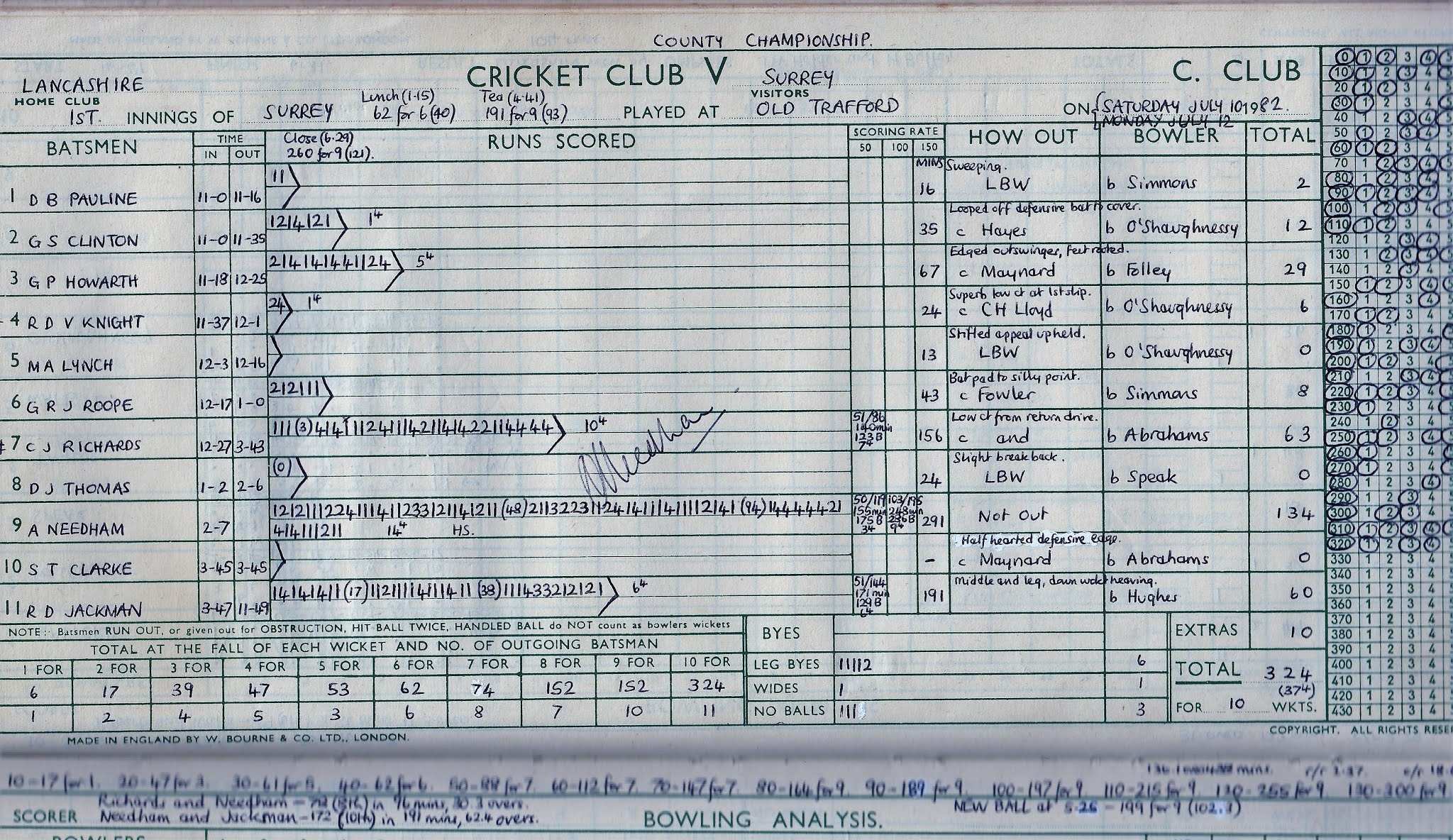
The sad news of Robin Jackman’s passing on Christmas Day reminded me of a famous game in which he played, the scorecard of which I found after a frantic loft search.

Jackman was a fine bowler for Surrey, winning England honours, famously nicknamed the Shoreditch Sparrow by the brilliant cricket-writer Alan Gibson in The Times.

Jackman, in 1982, was playing what proved his final season in England and my abiding memory is of him with the bat, not the ball.

This was also Andy Needham’s match.

It seemed just like another routine County Championship match at Old Trafford.

Lancashire v Surrey, Saturday 10 July 1982. Sunday League game the following day, days two and three of the county game to continue Monday and Tuesday. Simple. It’s how life was.


Of the Surrey side that played only Sylvester Clarke is missing from this team photo of the era. Back row (left to right): Bamber, Needham, Payne, Thomas, Wilson, Pauline, Lynch, Clinton, Hamer, Gibson. Front row: Smith, Intikhab Alam, Pocock, Roope, Knight, Stewart, Jackman, Howarth, Butcher, Richards.

Surrey batted first- and struggled. ‘Flat Jack’ Simmons, introduced into the Lancashire attack in the fifth over pinned opener Duncan Pauline lbw, sweeping, 6-1.

Grahame Clinton looped a catch off a defensive bat to cover, c Hayes b O’Shaughnessy (17-2), captain Roger Knight superbly caught at first slip off O’Shaughnessy by his opposite number, Clive Lloyd, 39-3.

Monte Lynch lbw O’Shaughnessy for a duck, 47-4, Kiwi Geoff Howarth, who’s hit five fours and looked comfortable, caught behind by Chris Maynard off Ian Folley for 29 (53-5). Hornby Stand, housing some of Lancashire’s most faithful supporters in raptures when Graham Roope caught bad pad by Graeme Fowler off Simmons (62-6). Time for lunch.

David Thomas, lbw Gary Speak, a Blackrod lad who opened the Lancashire bowling, 74-7.

Finally, resistance down the order. Wicketkeeper Jack Richards, no batting credentials of which to boast so far, highest score 63, joined by 25-year-old off-spinner Andy Needham, highest score 21. The Lancashire supporters rubbed their hands.

Unexpected resistance, stand of 76, dominated by Richards, showcasing the batting potential that made him an England wicketkeeper/bat. Ten fours, victim of the occasional off-spin of John Abrahams, caught and bowled for 63, 152-8. Sylvester Clarke came and went, caught behind off a half-hearted defensive edge, Abrahams, unbelievably on a hat-trick. Last man Robin Jackman repelled it, batted solidly. Needham, meanwhile, was growing in confidence, showing a solid range of attacking shots, the pair rotating the strike. Tea 191-9 off 93 overs. A good recovery.

The last session purgatory for the home side as Needham batted on, Jackman supporting him like any good, experienced pro would in the circumstances. As the shadows lengthened Surrey closed 260-9 off 121 overs, Needham 94 not out, Jackman undefeated on 38.

Sunday must have been a long day for Andy Needham, pondering his first first-class hundred. As county games were in those days, Sunday was all about the 40-over competition, the John Player League.

It was a mediocre game off memory, Surrey 172 all out, Jack Richards top-scorer with 52 off 34 balls in the middle order, Roope 35, Bernard Reidy, called up for the one-day game 4-28. Clive Lloyd steered Lancashire to a straightforward win by seven wickets, undefeated on 61, Needham 3-41 with his off spin in a losing cause.

Monday morning, a small crowd gathered at 11am, the retired and the work shy’s numbers boosted by students and school children on holiday. Needham on strike, single off Speak’s fourth ball taking him to 95.

Next over- O’Shaughnessy to Needham. Fourth ball, 4. 99. Sixth ball, 4. Maiden hundred. Handshakes all round, applause from the boundary, 248 minutes, 286 balls, nine fours.

The stand went on, just one short of the Surrey tenth wicket record of 173, established by Andy Ducat and Andy Sandham against Essex at Leyton in 1921 when Jackman was bowled, middle and leg by Hughes, heaving for 60. Needham 134 not out, 14 fours, Surrey 324 all out.


Later he kindly signed my scorebook. I always tried to get my ‘hundreds’ signed.

Needham’s day just got better. Lancashire 249 all out, only thanks to a quite superb 124 from the left-handed John Abrahams, batting at six, Needham 5-91 off 30.3 overs, a second career best in a day. The wickets of Hughes, O’Shaughnessy, Simmons, Folley and, finally, Abrahams, caught at point by Howarth.

Just enough time for the Surrey second innings to begin before nightfall, Needham sent in to accompany Pauline as opener. Single off the last ball of Speak’s first over, but as Simmons opened the Lancashire attack, popping the fourth ball to silly point, c Abrahams b Simmons 1.  Jackman came in as the second nightwatchman as Surrey closed 3 for 1 off 4 overs, 78 ahead.

The final day saw Jackman bat superbly again, finally out stumped by Chris Maynard off David Lloyd for 68. Surrey reached 176-7 off 64 overs before Knight declared, Roope undefeated on 49, Simmons 5-57.

Rumours had already circulated around the ground that Needham and his mate Pauline had celebrated his extraordinary Monday too hard, breaking a curfew. The two players were both suspended for the forthcoming Natwest Trophy tie against Northants by manager Micky Stewart.


The scorecard of a famous game

Suitably chastened Needham took the field with a Surrey side that had set Lancashire a challenging target of 252 to win in 100 minutes and 20 overs. Clive Lloyd was brilliant, imperiously leading his side towards their target, 76 in a shade under an hour, ten fours, one six, his sixth wicket stand of 88 with the in-form Abrahams (58) decisive. Last over, Lancashire 3 to win, Abrahams run out attempting a quick single off the third ball, Simmons making the winning hit with two balls remaining.

Needham? 15 overs, two for 113. Back to reality. As it was for me. Work on Wednesday after four great days at the cricket.

Needham had a glorious run in 1985, three centuries, 132 v Notts, 124 v Zimbabweans, 138 v Warwickshire, all at the Oval. To the surprise of many he left soon after for Middlesex and his career fizzled out, though he later performed well for Hertfordshire in the Minor Counties. Just over 3,000 first-class runs at 23, 123 wickets at 43 a modest haul for the talent he showed in what, for him, was a game to remember.


Wednesday, 6 January 2021

Cream Teas and Nutty Slack

Posted by Tony Hutton

One of the few benefits of lockdown is the ability to revisit my bookshelves and dig out long forgotten volumes from the past. Hence the unusual title, which is a fascinating book written by Jack Chapman in 2003. It is a history of club cricket in County Durham from 1751 to 2002. I came across it again while trawling the internet and to my surprise found the whole book is available to read there. Quickly found it in more traditional form on my shelves and enjoyed reading it yet again.


 Readers with good eyesight may just pick out a picture of Darlington cricket ground  below the team picture in the centre. Just to the right is the familiar face (and ears) of the former Yorkshire opening bowler Alex Coxon, who became a legend in Durham league cricket not only for his all round cricketing ability but for his fiery temper as well. Probably unknown to most will be the pavilion top left, which turns out to be the original Ropery Lane, Chester-le-Street building opened in 1904.

The picture at the bottom centre of the page is in fact of the Racecourse Ground in Durham City, with an illustration of a match between Twenty Two of Durham v All England Eleven in 1849, and well worthy of enlarging to study the scene not very much different from today.


However the book starts nearly a hundred years earlier than this with the first reported match in the county taking place at Raby Castle in 1751. In fact this was the second of two games within a week between the Earl of Northumberland's team and the Duke of Cleveland's side. The first game had been played just over the county boundary at Stanwick, the Earl's seat in North Yorkshire and the return fixture at Raby Castle near Staindrop in County Durham. The local press reported that both games were won by the Earl of Northumberland's side by a great number of notches.

Cricket at Raby Castle in 2009.

Such matches were rarely reported in the press in those days and it is hard to establish just how quickly the game spread throughout the county. There is a report of a game at Piecebridge, on the River Tees in 1773 when the gentlemen of West Auckland played the gentlemen of Scruton, North Yorkshire for a stake of 25 guineas. West Auckland were the winners of a three innings game and promptly challenged any club within a fifty mile radius for the same sum of money.

Club cricket became really established at the start of the nineteenth century with the Sunderland club founded as early as 1801. Neutral venues were often used in these early days, but the biggest expansion occurred following the opening of the Stockton and Darlington railway in 1825. Crowds increased and clubs were able to travel farther afield. Cricket matches became great social events with local traders jumping on the bandwagon to make money from selling food and drink. Disputes over betting and the composition of teams became common place.

Professionals started to be employed later in the century, often from far afield and disputes continued over bowling actions until over arm bowling was approved in 1864. League cricket was established in 1891 and the story continues in great detail up to the beginning of the present century. One of the most interesting features of the book are the pen pictures of professional cricketers over the years which give a fascinating insight into cricket over the years. For instance Denis Hendren, brother of the more famous 'Patsy' Hendren, had played for Middlesex, but played for about half a dozen Durham clubs between 1907 and 1930. Highly successful his mannerisms were reported to be 'many and strange'.

In more recent times well known overseas names such as Clayton Lambert, Wasim Raja, Derick Parry, Clyde Butts and West Indian brothers Dennison and Wesley Thomas appeared. In 1993 Dennison Thomas achieved the rare feat of the 'double' scoring over a thousand runs and taking 100 wickets. A detailed statistical section appears at the end of the book, completing an excellent study of league cricket which has always been played so enthusiastically in County Durham. A wonderful read.

Monday, 4 January 2021

Three Test cricketers in just another game in the Bolton League, 1985

By Mike Latham

It was just another game in the Bolton Cricket League in 1985, Egerton v Tonge, Saturday 27 July.

I always like going to Egerton, a compact ground with stunning views across the West Pennine Moors and packed my trusty Practika camera and monopod.

Located on the left-hand side of the village, on the A666 from Bolton heading towards Darwen and Blackburn, just after the turn off for Longworth Road that leads towards Belmont, the ground was always well patronised and an integral part of the local community.

The Bolton League was strong back then, highly competitive with 14 member clubs, dominated that season by Farnworth and Farnworth Social Circle.

The two rivals took the championship battle to the final ball, Farnworth’s failure to dislodge the last Greenmount batsmen meaning the title went to their friends at Piggott Park.

The West Indies pair of Rod Estwick and Vic Sandiford ruled the roost at Social Circle, two Barabadians with great cricketing talent.

Estwick, a fearsome fast bowler in his pomp, one of the West Indies coaching staff on their tour of England last year, was the leading wicket-taker in the league that year, 116 wickets at 12 apiece. Sandiford, a highly rated all-rounder scored 838 runs at 38, took 79 wickets at 16. Not bad for an amateur.

Farnworth had Rod Tucker, now an internationally acclaimed umpire from New South Wales as their professional. 913 runs at 35, 73 wickets at 13. Tucker brought along with him a fearsome left arm bowler by the name of Andy Jones. An amateur, 82 wickets at 10.42. Top of the averages.

The Bolton League, you see, was a tough school for aspiring cricketers, whether from home or overseas. But wining the league was all that mattered. There were no prizes for second.

Westhoughton had the great Dilip Vegsarkar as professional. Then rated as the world’s greatest batsman in the newly formed Deloittes World Rankings. When he had to leave for home early, they recruited West Indies star Collis King as sub-pro for the last few games. They trailed in third.

Among the also-rans (fourth) were Tonge whose pro Chetan Sharma was a talented young Indian Test player with a great attitude and obvious ability.

Though only 19, he had made his Test debut for India the previous winter, had already tasted league cricket during a spell as overseas amateur with Morecambe in the Northern League in 1984, alongside his fellow countryman, Ravi Shastri.

Egerton recruited a young New South Wales all-rounder by the name of Steve Waugh as professional. ‘Do you mind if I bring along my twin brother as amateur?’ he asked. ‘Don’t mind if you do,’ the reply.

The brothers played one game together, a pre-season friendly at Bolton Association side Atherton. Both scored hundreds. After that Steve was quickly recruited to Essex on a scholarship, Mark taking over as pro. He brought in a young opening batsman from Western Australia, Mark McPhee, as the team’s overseas amateur.


Mark McPhee in the runs, Mark Waugh non-striker

Steve went on to make his Test debut for Australia against India, Boxing Day 1985 at Melbourne. The first of 168 Tests, with 325 ODIs thrown in, Test average of over 50, including 32 centuries. Mark had to wait five years for his Test debut, but didn’t do too badly either, 128 Tests, batting average of 41, 20 centuries, 244 ODIs, batting average 39, 18 centuries.

All that sounds like the league was dominated by players from overseas. It was, to a certain extent but there was a huge pool of talented local players, some who’d played the first-class game, others who aspired to those ranks.

The Bolton League was seen as the place where you could find how far you could go in the game.

Back to that late July day at Egerton. It had been a weather-affected summer, no surprise when morning rain delayed the start until 2pm.

Egerton, batting first, had McPhee, an aggressive opener with a wide range of shots, In typically robust form.


Mark McPhee drives Chetan Sharma through the onside

At the halfway stage of a contest reduced to 48 overs per side they were well placed at 95 for 2.

Sharma, who had a rhythmic action with a big delivery stride and a long sweep of his right arm had bowled with sustained hostility and aggression.


Mark Waugh hits out against Chetan Sharma

For once Waugh, in what was a golden summer for him, missed out, caught by Sharma at mid-wicket off Nigel Tebay for just 5. A rare loose shot and failure in a season that brought him 1,359 runs at 54, top of the league’s batting averages, third highest runs aggregate in league history..

McPhee made 66 out of 95 with nine fours and two sixes, threatening the cottages behind the wicket at the south end of the ground with damage. But Sharma’s persistence paid off, caught behind by the young wicketkeeper.

Young wicketkeeper? Looks familiar. Let’s check. That’s Warren Hegg, future Lancashire stalwart, two Tests for England.


Wicket for Chetan Sharma- N Hurst, ct Rogers, Warren Hegg the wicketkeeper

The last eight Egerton wickets fell for 52 runs, 147 all out, Sharma 7 for 43 in 22.4 overs. Bowling unchanged. Unless something untoward happened, the professional always bowled unchanged.

In reply Tonge were struggling at 55 for 4, two wickets to Waugh, another to Ian Taylor, talented all-rounder who opened the batting and the bowling.


Egerton bowler Ken Dickinson appeals unsuccessfully for a stumping, Chetan Sharma non-striker


Ian Taylor bowls Tonge’s Mike Rogers


Mark Waugh gets a wicket, Nigel Partington lbw

Sharma, batting at four, played a highly responsible innings, dealing well with Waugh’s bowling, scoring off the loose balls. Gradually he helped wrest the initiative his side’s way, completing his half-century after 105 minutes of careful concentration, scoring the winning runs in the 43rd over with a fine cover drive for four off Waugh.

Chetan Sharma finished the season with 695 runs at 46, 89 wickets at 11. He's still remembered fondly in Tonge. Not only for his stats but for the way he played the game.

Egerton 147 (McPhee 66, Sharma 7-43), Tonge 149-6 (Sharma 56no, Waugh 3-49)

Tonge won by 4 wickets at 7.34pm.


.


Sunday, 3 January 2021

A Singular ending to a Cricket Match

 By Mike Latham

A pre-Lockdown trip to Huddersfield, back last February saw me take in sights of the town’s glorious sporting past. The George Hotel, where the Northern Union (later re-named, in 1922, the Rugby Football League) was formed and Fartown, spiritual home of Huddersfield cricket and rugby.

Our Yorkshire based friends who kindly read these pages will be all too familiar with the magnificent memorial that still stands at the near-derelict former home of cricket in the town, dedicated to three great local players, Wilfred Rhodes, George Hirst and Schofield Haigh.


Schofield Haigh passed away of heart trouble at the age of 49 in 1921.

I thought about Haigh the other day, by chance when looking back at the career of the Kent wicketkeeper Jack Hubble and found reference to a famous match (or should it be infamous) I never knew happened.

Yorkshire v Kent at Harrogate, 7 July 1904. A glorious summer’s day, a crowd of 4,000 on the first day (Thursday), Kent winning the toss and batting on what looked a perfect pitch.

They reckoned without the brilliance of Haigh, entering the attack with the visitors 62 for 1, Alec Hearne and James Seymour batting well, bowling unchanged for the rest of the innings. He bowled immaculately, starting well by pitching the ball on a length straight away. Knowledgeable Yorkshire members knew what that meant- when Haigh started well, he invariably did well.

Haigh took six wickets- five clean bowled- as Kent succumbed to 177 all out. By the close of the first day Yorkshire, not without difficulty, were 35 ahead, 212-7. Haigh, in glorious batting form after centuries against Warwickshire and Derbyshire in his previous two matches, 38 not out.

Cricket was different in those days. ‘In five-and-a-half hours only 389 runs were obtained,’ read one report.

Hubble, unbeaten on 33 and playing only his second game as deputy for Fred Huish, sidelined by illness, was impressive with the bat and gloves, the forerunner to a great county career.


Jack Hubble

In the closing stages of the first day Colin Blythe made the ball turn square on occasions and it was noticeable that the pitch was cracking up alarmingly at the pavilion end. Walking to the game on the second morning, many of the Yorkshire players had mentioned this fact to the local correspondent. They had high hopes of a two-day win.

Haigh batted on as Yorkshire established a first innings lead of 102, which looked invaluable under the circumstances. Not without moments of luck- he was dropped twice- he finished unbeaten on 74 as Yorkshire’s first innings closed on 279. Blythe bowled a long spell, rewarded with 5-125, off-spinner Bill Fairservice taking 4-74 at the other end.


Colin Blythe

But closer inspection of the pitch revealed that the end previously cracked and breaking up was now smooth and damp. An urgent confab was in order.

At the close of the Yorkshire innings, Lord Hawke, the Yorkshire captain, met in the middle with the Kent amateurs (reflecting the social deference of the day) and the two umpires. Two old Etonians, his Lordship and Kent’s Cloudesley Marsham did most of the talking.  They agreed to let the umpires decide.

The umpires were Dick Pougher, an old Leicestershire stalwart who had played one Test for England and William Shrewsbury, a Notts man and brother of the late, great Arthur Shrewsbury.

They decided that the pitch had been ‘doctored’ and declared the match null and void, not to count in the county championship.

To appease the spectators, as another good-sized crowd had gathered, it was agreed to play on until 5pm and then bring a conclusion to events, abandoning the scheduled third day.

None of the performances in the match were to count in the national averages.

Old Ebor in the Yorkshire Evening Post described the scene: ‘It was a bitter disappointment, and one could not help wondering what would have been said by the crowd at Sheffield, Leeds, Bradford, Birmingham, and other large towns had a similar incident occurred that robbed them of the serious cricket they had paid to see. Fortunately, it was a fashionable crowd at Harrogate, and some of the onlookers simply raised their eyebrows, exclaimed “Dear me!" and went to the gardens, or the Kursaal or the Stray for compensation.’

Kent went into bat and amassed 321 in a somewhat relaxed manner. Hearne made 64, Robert Livesay 69, Marsham an unbeaten 76 and last man Arthur Fielder smashed 37 in ten minutes at the crease.

Yorkshire called up veteran Lees Whitehead as a replacement for George Hirst and he bowled more overs than anyone else.

Old Ebor called it farcical that a substitute had been called upon.

Ironically on the same day Lancashire were allowed a substitute in their three-day match against an England XI at Blackpool,  Albert Ward allowed to replace the injured Les Poidevin. Ward hit 112 in the Lancashire second innings, but the England XI still won by eight wickets. Despite the talent on show this match was not afforded first-class status.

Meanwhile back at Harrogate Haigh, called into the attack late on, disdained to remove his sweater, bowled slow leg-breaks and, to his amusement, garnered a hat-trick in his first over, the wickets of Hubble, Fairservice and Blythe, caught, stumped and bowled respectively.

The press had a field day.

The Yorkshire Evening Post carried the headline: GAME NOT TO COUNT IN THE CHAMPIONSHIP. PLAY TO FINISH TO-NIGHT.

Old Ebor carried out his own investigation and spoke to the groundsman, Joseph Redfearn, a former Yorkshire player, who made one first-class appearance in 1880.


Lord Hawke


Mr CHB Marsham

He flatly denied doing anything improper, stating he could not say whether anyone had tampered with the wicket. He pointed out there was a watchman on all night. But, as Old Ebor added, Lord Hawke, Mr Marsham and the two umpires would not have been parties to such a serious decision without very grave cause.

‘As the result of a conversation which I have had with one of the umpires, and others who were on the ground early this morning, there can no doubt that water was used for the purpose of what may be called re-binding the wicket,’ Old Ebor wrote. ‘But who was the responsible for this proceeding one cannot, in the face of Redfern’s earnest disclaimer, pretend to say. The contretemps is the sole topic conversation on the ground.’

The events made news nationwide.

The Edinburgh Evening News headline was: CRICKET FIASCO AT HARROGATE.

‘As briefly reported yesterday, the match between the Yorkshire and Kent elevens at Harrogate ended yesterday, under circumstances fortunately without parallel county cricket. It was abandoned on the grounds that the wicket had been tampered with, contrary to Law 9 In Cricket.'

Later on the Friday the Harrogate club issued a statement, unanimously agreed by all 17 members of the committee passing a unanimous vote of confidence in Redfearn, at the club seven years and held in high esteem, and stating the improvement in the pitch, after their exhaustive enquiry, was due solely to climatic influences, there having been a very heavy dew which caused the clay, of which the wicket is largely composed, to roll flat, and give the players an even better wicket than on the previous day.

Old Ebor concluded: ‘The resolution is, I need hardly point out, in direct contradiction of the belief of the captains, umpires, and players that someone or other had tampered with the wicket. All that I care say about the matter is that Lord Hawke and Mr CHB Marsham on the one side and Messrs AD Pougher and W Shrewsbury on the other, would not be parties to such a serious and unique step in the cancellation of a county championship match without being perfectly satisfied in their own minds that there was grave reason why this extreme course should be taken.’


The biggest loser was Schofield Haigh (pictured above), who hit 74 not out and took six wickets at a period of the game when it was played under first-class conditions, having his performance expunged from the record books.

Surely there is a case for stating that the two first innings should count in the first-class records?

When another infamous pitch incident occurred, after four days of play in the third Test between England and Australia at Headingley in 1975 the play that had occurred quite properly counted in Test and first-class records. But the latter is a story for another day.

Friday, 1 January 2021

A sad centenary

 posted by John Winn

Yesterday marked the centenary of the beginning of a test career that lasted only four days. On December 31st 1920 Dr Roy Lindsay Park an Australian cricketer and 'Aussie Rules' player made his test debut. The occasion was the second test in the 1920-21 series between Australia and England, played at the MCG with England already one down in the series after a crushing defeat at Sydney. Australia got off to 'a capital start' (Wisden) with Bardsley and Collins adding 116 for the first wicket before the latter was dismissed by Warwickshire's Harry Howell for 64. Enter Park, playing only because Macartney was suffering from gastritis, to be bowled first ball by Howell who too was playing in his first test. Howell claimed that the momentous delivery was the finest he delivered in his whole career. Added poignancy is given to the story if we accept the truth of the legend that says that Park's wife, Alice, who was combining spectating with knitting dropped a stitch which distracted her attention from the cricket and thus missed the whole of her husband's test career as a batsman. Australia were not required to bat a second time and although 'Parkie' as he was imaginatively known was named as twelfth man for the third test he was never picked again for his country. That he bowled one wicketless over for nine runs in England's first innings probably afforded little comfort. 

On his return to the pavilion Park received much sympathetic applause for he was an immensely popular man both as a sportsman and a doctor. Sadly he did not have a long life for he died in 1947 aged 54 by which time he was a widower for the unfortunate Alice had died fourteen years earlier. They had two children, a son also Roy who followed in his father's footsteps as a doctor and a daughter Alice who married Ian Johnson, a future captain of Australia. Given that Johnson  played against England in 1946 it is possible that Dr Park saw his son-in-law play test cricket. Let's hope so. 

Harry Howell is also an interesting figure and in some ways a sad one for he too died prematurely, aged just 41 and in his five tests for England Wisden remarks that his slips 'failed him wretchedly'. He dropped out of county cricket in 1929 but like Park his sporting skills were not confined to cricket for he played professional football for Wolves, Port Vale, Stoke City and Accrington Stanley. The cause of his premature death, to me at least, remains a mystery.